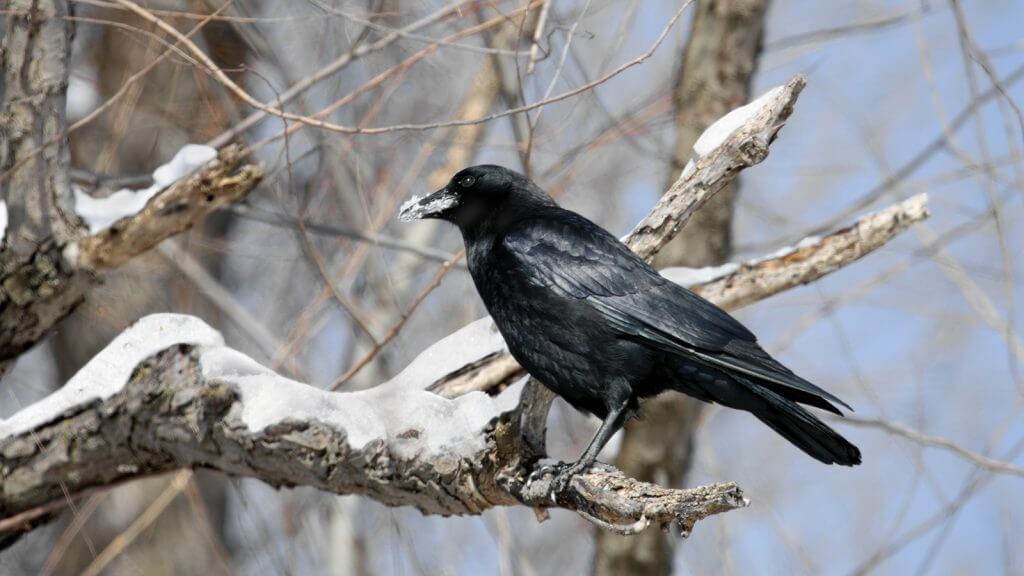
Joseph Schmidt’s “Winter Fall Nevermore” showcases flux, response to trauma, and ultimately resilience. The poem lays out a simple tale of the winter snows exacerbating a crow that then destroys an inhabitant’s home, but the speakers’ inner lives play out beneath every line.
Winter Fall Nevermore
By Joseph Schmidt
A fickle pat of winter snow
Cascades upon my sheltered home,
For herein lies the darkest crow.
“Winter Fall Nevermore” is an utterance of desperation, an exhortation rather than a command. The title asks the impossible of nature – to cut off a season necessary for ecological health. It also hints at a deeper meaning; The winter is not intrinsically bad, but rather the troubles it brings for living things under nature’s influence. With nature holding such sway, life cannot divorce itself from hardship.
The poem begins with snow falling down, indicating the season and the stakes for both speakers. “Winter” is explicitly stated, but the nature of the speaker is ambiguous – going off this stanza alone, it could be that this first speaker is the crow, although this will be contradicted by later stanzas. The snow’s description as “fickle” conveys the changing essence of nature. After all, thought of as one entity, the same wilderness that brings the killing and displacing snows also brings the prosperity of spring and summer.
A nested bird stationed below
In warm, crisp sittings beneath my dome.
For snow comes piling both deep and slow.
Stanza Two elaborates on this crow, describing it as a squatter of sorts living beneath the speaker’s home. This distinguishes the two, as the owner of the “dome” is an inhabitant, almost certainly a human, while the crow’s nest is beneath his home. The diction of this nest being “stationed” implies that it was made over time, and the “warm, crisp sittings” imply a discerning judgment while the crow was building its dwelling. None of this helps it against nature, however, as the cold continues to invade his home.
I sit and watch ice overflow
Cause beady eyes to dart and comb,
Where fanfare of creaking breaks status quo.
Here the speaker uses the first person for the first time. He observes the crow’s anxiety rising with the snow, as the bird finally loses its composure and his nest. The snow ruins the crow’s work, taking everything from him, and so the bird can no longer live peacefully under the inhabitant’s home. The status quo is broken. The reader sees again the unpredictability of nature, this time expressed through the crow. Though the bird is a victim of nature, it is also a part of nature, as evidenced by the vulnerability brought about due its connection to the weather. Despite the anthropomorphization of the crow in Stanza Two, Stanzas Three and Four clearly outline the differences in the two speakers.
It cannot break the place I grow,
The deep, dark corners my mind will roam.
It peaks its eye with winter glow.
Knowing that he himself is safe, the first speaker takes no action. This stanza elaborates on his view of the winter, but also allows the reader to infer about him.The inhabitant is different than the crow, impervious to winter after having literally insulated himself from nature. The crow tried to do the same thing with his nest, but failed. By contrast, his success affords the inhabitant the opportunity to “grow” and to think, possibly distancing himself further from nature in the process; After all, the key concern of the wild animals is survival, as evidenced by the care the crow took in creating his nest.
A cackling screaming as feather’s throw,
Knock pictures, valuables, a rolling pome.
My house, my mess, from long ago.
The speaker finally finds himself personally affected – the outside could not touch him directly, but the crow certainly can, flying up and creating an avian whirlwind. This pierces through his ruminations, and the disorder extends to his house. The parallel is incomplete, however: A mess differs from destruction, illuminating the safety net that the inhabitant has, which the crow does not.
Came thundering in, my hated foe,
Compressed my body in a chilling foam.
Complete destruction and nothing to show.
Here the poem changes speakers, shifting from the perspective of the inhabitant to that of the crow who has been encased in snow. The first line is his immediate reaction at this relative avalanche, and contains the fact that the crow has encountered snow before; It may well be that this is not the first time he has been made a vagrant. The second line is the crow’s immediate hardship, of course, and likely a terrible experience – akin to being caught in an avalanche. However, the third line displays the deeper cause for the crow’s enmity: Nature has repeatedly left him with “nothing to show.” He must start again from nothing, in the harshest of seasons, as he has before.
It sees the damage, the deadly blow,
Flies searching for a temporary brome.
Taking with it a mantra it can never outgrow:
The poem changes back – the inhabitant sees the crow reacting to its nest’s destruction. The crow cannot make a permanent place for itself, unlike the inhabitant, and so seeks its “temporary brome.” Nature has provided him survival, but not prosperity.
My prayer to me will always be
May the winter fall nevermore.
The crow will forever be subject to the constraints of nature – this is why it can never “outgrow” its futile prayer. The inhabitant remains in his home while the crow flees, despite both of them being subject to natural intrusion. The inhabitant can look on his fellow speaker with pity, however, as his home can be reordered while the crow must start anew. Read another way, this prayer could be from the inhabitant’s perspective; Raising himself above nature, he has in a way deified himself. His prayers need only go to him, and he can make them reality. Inside his sheltered home, free from the last influence of nature, winter may fall nevermore.

 Disassembly