
“In an age like ours…”
Notice: The following contains spoilers and rambling thoughts about the movie Parasite.
If you want focused writing, read The Atlantic.
In 2019, director Bong Joon-ho released Gisaengchung, known abroad as Parasite, a modern fable about poverty, inequality, and power with elements of comedy and horror. He lays out the situations of two families, the Kims and the Parks. Each have a father and a mother with male and female children, but in all other respects they differ. Bong Joon-ho has experience in similar allegorical tales with themes of wealth disparity, as with 2013’s Snowpiercer. With Parasite, he has mastered his thesis: Power and desperation change behavior.
Set in South Korea, the impoverished Kim family infiltrates the lives of wealthy Park family, ousting their previous domestic servants and through forgery gaining employment. Throughout the film, the audience sees a power imbalance in the form of wealth, emotional manipulation, and blackmail.

Cinematographer Hong Kyung-pyo opens on a shot of an alley from a window, and then moves the camera down on a pedestal shot, giving the impression that the room is sinking as he brings Kim Ki-woo into focus. The Kim family lives in a semi-basement, with the windows high up on the wall giving the view of someone lying down on the alley above them. Parasite begins with a crisis for the Kims; Their stolen WiFi network now has a password locking it. Their phones having long since been disconnected, the family has no way to be contacted for gig work, their primary source of income. Rather than panicking, though, they immediately go through a checklist of solutions. Kim Ki-jung, daughter and forgery expert, suggests common passwords to try. Kim Chung-sook, the matriarch of the family, spurs her husband to action, and Kim Ki-taek – planner, driver, and father – sends his daughter and son, Kim Ki-woo, to check every corner of the house for new networks, leading them to find a network and a gig folding pizza boxes.
There are always setbacks for the Kim family, and no safety nets. While folding, a fumigator sprays the alley. Rather than close the windows, Ki-taek elects to leave them open as “free extermination” to kill the stinkbugs infesting their apartment. The shot of him folding determinedly in the midst of the gas while his family coughs around him sets up his focused nature and his resolve, just as the next scene establishes Chung-sook’s character as she argues with their contact from the pizza place. They attempt to get Ki-woo a job, and the film displays one of its many instances of foreshadowing; Ki-jung throws her friend who works at the pizza place under the bus in an attempt to replace him, and both siblings isolate the employee. The audience will come to learn that this is their strategy, although it fails in this instance.
Upon being paid, the family sits down together to eat, but in the midst of Ki-taek giving thanks for their phones being reconnected, they are interrupted by a vagrant urinating on the wall next to their home. Bong Joon-ho accurately portrays impoverished life: Something always comes up. Ki-taek also hits his head on the cabinet above his seat, which is a subtle and effective demonstration of the daily discomforts of poverty. The vagrant and their family life are interrupted, however, by the arrival of Min-hyuk, Ki-woo’s friend. Min is in college and from a well-off family, and has come to Ki-woo as the only one he can trust with a job tutoring a young girl from the rich Park family, Da-hye. Though they are friends, there are still divisions between them. It is implied that Kiwoo has been hiding his family from Min when the latter says, “Thanks to that rock, I saw your parents.” The family is also embarrassed to admit that their celebratory feast at being paid, made largely of cheap junk food, is their dinner.
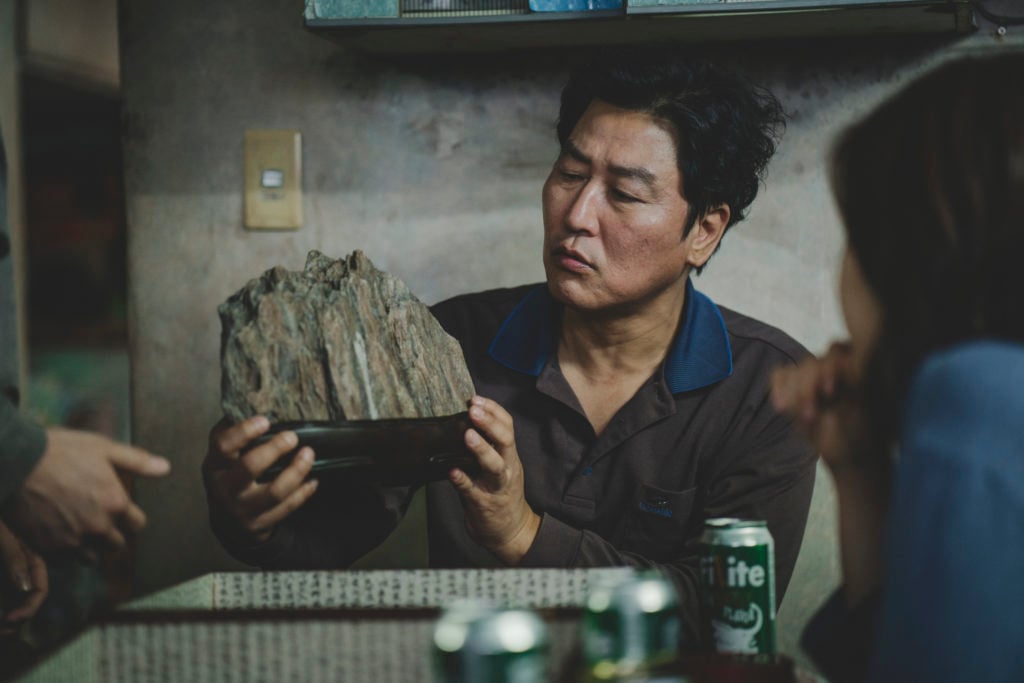
Along with the job offer, Min also delivers a scholar’s rock – a heavy stone landscape of a mountain range said to bring wealth. Ki-woo initially has something of a childish, wondrous reaction to it, exclaiming that “This is so metaphorical.” His mother, in another establishing character moment, is more practical about the gift – “food would be better.” The characters move on to the issue of Ki-woo not having the credentials to tutor Park Da-hye. Min calls him out as having proven his knowledge of English through multiple tests, including his military exam; It is arbitrary that working society values the university exams and not the ones Ki-woo has taken.
The audience then sees that Ki-jung also has skills that the credential-focused society does not recognize; She’s a Photoshop expert, and according to Ki-taek, would be “top of her class” at document forgery at Oxford. Her skill and Min’s recommendation get Ki-woo in the door, and he sees the compound that the Parks live in. Palatial compared to the semi-basement and constructed by the famous architect Namgoong, the house takes on a character of its own throughout the film and symbolizes South Korea as a whole, with its levels, secrets, and promises of opportunity.
Cinematography in Parasite, aided by this mansion, is a pathway for symbolism. The backyard in so many shots of the film, for instance, looks vast as though it’s intended to be the beginnings of a forest, but a hint of wall can be seen behind it, showing the limits behind the possibility that the Kim family believes in.
Although “young and simple,” Choi Yeon-gyo, mother of the Park family and manager of the household’s servants, would likely not have allowed Ki-woo in to the house without a degree, even as she says they do not matter to her. The first tutoring lesson is a great performance by Ki-woo, and an even better one by his actor, Choi Woo-shik. The lesson is devoid of any teaching, but Ki-woo has a monologue about the mentality behind test-taking, as if he’s done it a thousand times, and both mother and daughter are impressed at his approach.

This begins the first phase of what is essentially a heist for the Kim family, a “belt of trust” that involves each of them recommending the services of another until they are all hired. As with any good heist movie, they intercut the preparation with the job itself – showing the rehearsal, the gathering of peach fuzz for the poisoning, and the familiarization with the Benz. Advertising is based on one thing: Fear. The Kim family has taken that foundation and built an art form off of it. Each member meets their mark, isolates them when possible, takes in information, identifies their concerns, grows them into anxieties, and then presents another Kim as the solution. Their lies and embellishment are strange, but truly only slightly more deception than some job interviews require.
Park Da-song, the youngest child, is heavily indulged due to a past trauma, but a good-natured boy despite this. Ki-Jung’s stern, disciplinarian nature fits perfectly with his rambunctiousness, making him act calmly around his family. Park Da-hye is eternally overlooked by her family, and so Ki-woo simply gives her any attention, and she develops a crush on him, cementing his position as a tutor “regardless of her grades.” The Kims solve the Parks’ problems easily because they were never that large to begin with.
The Kim family both have and are the titular parasites. Institutional poverty is sucking them dry, giving them daily hardships and testing their resilience; Living in a society where “An opening for a security guard attracts five hundred university graduates” has driven them to desperate measures. However, they are parasites themselves as well, an invasive species having infiltrated the Park household, replaced their competition through subterfuge, and taken hold in the home and psyche of the Parks. The power dynamics between the two fascinate; The Kims have the solutions to all of the Parks’ problems, of course, so the Parks are dependent and grateful, but the Kims also rely on the Parks exclusively for income, and are at the beck and call of their wealthy patrons. At any moment they could be called to work, and Choi Yeon-gyo even names Ki-woo “Kevin” without consulting him. The Parks may be “so gullible,” but they are unquestionably in charge.

Perhaps the most straightforward example of the Park-Kim dynamic lies in Kim Ki-taek driving Park Dong-ik. The two fathers seem to get along initially, but Dong-ik tests Ki-taek the entire way through, superseding any friendly companionship the two allude to. He criticizes Moon Gook-gwang after she has been fired, displaying how little her years of service meant to him. At any moment, Ki-taek could be talking to his “friend” but be silenced by a word from his boss, as when Dong-ik snaps at him to watch the road.
Hong Kyung-pyo opens the second act with a series of tracking shots of the two families inhabiting the same home, inhabiting their parts as they secretly interact with each other behind the backs of the oblivious Parks. The Parks leave on a camping trip for Da-song’s birthday, and the Kims do what they have always done when coming into wealth – celebrate. They make themselves at home in their employers’ compound, drinking their liquor, bathing in their bathrooms, and making a mess. Ki-woo even reads Da-hye’s diary to better court her. As soon as they are able, they celebrate to stave off the desperate feeling of not having enough to live, of spiraling further into poverty.

The family talks about their relative position to the Parks. Ki-woo lays out his plan to marry Da-hye eventually, which leads to one of the few motherly sentiments in the film, with Chung-sook saying, “I like her. She’s a good kid.” The family often treats each other as partners first, and this practical dynamic invades even Ki-woo’s wildest “daydreaming,” as he notes that if they did marry, he would need to hire actors to play his parents.
As the alcohol flows, Ki-taek and Ki-woo wonder about the people they have replaced. Driver Yoon “must’ve found a better job,” and landed on his feet, to assuage their guilty consciences. This immediately provokes an outburst from Ki-jung, who drunkenly makes her point that “We’re the ones who need help. Worry about us, okay?” Her self-centeredness is a natural response to being chronically ignored, for instance by art schools or employers. In general, the Kim ladies seem more outwardly pitiless, with the intention to “just focus on us.” Ki-taek and Ki-woo at least sympathize with Gook Moon-gwang and Yoon, but ultimately, their actions are the same.
Ki-taek questions what the difference is between them and the Parks, since they inhabit the same place, but the mother points out the vast difference – the Kims are not there properly, and would scatter like the cockroaches in their real home if they were found out.
Discussion of Choi Yeon-gyo leads to the conclusion that she is nice – Ki-taek wonders at her being affable even though she’s rich, but Chung-sook asserts that she is only “nice because she’s rich.” The Kim parents compare wealth to an iron; The Parks polish is because they have “no creases on them.” Chung-sook claims that she would be as nice if she had wealth.
Events soon challenge her kindness, however. Parasite takes a tonal shift near the halfway mark, interrupting the celebration with a doorbell chime. The recently-fired Gook Moon-gwang, standing in the rain and appearing slightly crazed through the video camera, asking, “Would you let me in?” Her strange behavior continues in the compound, with her instinctively noting the large mess the Kims have left as the rest of the family hide to maintain the ruse, and beelining to the basement.
Parasite is mainly a comedy, but Bong Joon-ho’s suspense elements come into play in this second half. After her predecessor disappears into the dark cellar, Chung-sook follows her down, and sees her struggling to push open a jammed sliding cabinet. The Kim matriarch removes the jam, and Moon-gwang thumps directly onto the floor. Sound supervisor Tae-young Choi makes the audience feel the weight of the old housekeeper crashing onto the hard floor, bringing more realism into the film. Every hit in the film feels real.

Moon-gwang gets up immediately, still looking possessed, and immediately descends into the secret staircase behind the cabinet, screaming the entire way. The tension rises along with the score as Chung-sook follows her, her family watching from around the corner, and she goes deeper and deeper down into the concrete bunker to find another voice has joined Moon-gwang’s. She turns a corner and sees the maid talking to a middle-aged man, feeding him from a bottle. Chung-sook is understandably disturbed as the woman she usurped explains.
Oh Geun-sae, Moon-gwang’s husband, is a wanted man. Loan sharks have been hunting him since his Taiwanese cake shop went under, and so his wife snuck him into the house and is now here to feed him, having cut the CCTV cameras. For the past four years he has lived in the bunker under Namgoong’s compound, which even the Kims do not know about; In response to this story, more than a little similar to her own (the Taiwanese cake shop is even implied to be a former job for Ki-taek), Chung-sook begins to call the police.
Gook Moon-gwang begs her usurper, on her knees, to take money to feed her husband “as fellow members of the needy.” Chung-sook immediately denies her, cutting her hopes off with a statement that would divide them utterly if it were not a lie: “I’m not needy.” The power she holds over her counterpart has not changed her as she said it would, and refusing to be paid for feeding a wanted man once a week proves that she certainly isn’t any nicer.
Her lies find her out, however, as the rest of the family collapses out into the open. Moon-gwang records them, and the pendulum swings away from the Kim family. Suddenly, Chung-sook is asking to talk things over, and Moon-gwang gives as good as she got, calling her a “filthy bitch” and making the family kneel while she and Geun-sae relax on the same couch the Kims did just moments before. Her indignities are not contained to Chung-sook’s behavior, though; The couple hates the Kims for disrespecting the “masterwork by the great Namgoong,” as well, reprimanding them for their drunken celebration. They see themselves as more worthy of the compound because they appreciate its “creative spirit,” conveniently ignoring that they are as much squatters as the Kim family.
Composer Jung Jae-il’s score heightens the emotions of the film, and a music choice perfectly complements what comes next: “In Ginocchio Da Te,” a ‘60s crooner, plays as a slow-motion brawl ensues between the two families. The Kims spot an opening and rush in, desperately grabbing for the phone to delete the video. Geun-sae wrestles while Moon-gwang beats the impostors over the head with a heavy bottle.
Kim Ki-jung does not suffer this lightly, and adds biological warfare to the class warfare, grabbing peaches and inducing anaphylaxis on the elderly housekeeper. The family holds down Geun-sae and deletes the video, just as the phone begins to ring. The tension ramps up and shifts here, as the Parks inform Chung-sook that the rain forced them to cancel the camping trip and that they will be back in eight minutes. The Kims have to force Moon-gwang and Geun-sae into the bunker, tie them up, clean up their huge mess, hide themselves, and to cap it all off, Chung-sook has to learn how to cook ramdon. Hong Kyung-pyo expertly intercuts brutal scenes of Ki-woo dragging the unconscious Moon-gwang through the harsh concrete bunker with Chung-sook cooking, lending an air of tension but also absurdity to the sequence.

They barely pull this off; Ki-woo dives under Da-hye’s bed just after replacing her diary and Ki-jung slides under the living room table as the family reaches the second floor. Chung-sook finishes plating the ramdon in the nick of time, only to discover that Da-song doesn’t want it. Only Ki-taek fails in his task of guarding the prisoners, and Moon-gwang makes a mad dash for the surface, screaming for the employer who fired her, only to be kicked down the stairs at the last second. Chung-sook unknowingly seals her family’s fate in that kick, and the audience is party to another disturbingly realistic hit as Chung-sook’s head hits the concrete. The pressure does not completely ease up, just as the Kim family must keep working even after all they’ve done, either as a housekeeper or to sneak out from the compound.
Combined with this are further disturbing revelations. In the bunker, Geun-sae goes through a daily ritual – manually turning on the lights as Park Dong-ik climbs the stairs. This has taken on a religious importance for him; Even bound, he hits the switches with his head, and offers thanks to the picture of Dong-ik taped to the wall. He also hold more sinister intentions – he sends messages in Morse code through the lights, hoping that Park Da-song will be able to read them, as a scout.
Upstairs, Geun-sae and Da-song come up in another conversation; Choi Yeon-gyo tells Chung-sook about the trauma he endured two years ago on his birthday. Eating his cake at night, Da-song sees Geun-sae peering from the basement, his eyes crazed. This immediately leads him to seizing; Actress Cho Yeo-jeong takes advantage of the opportunity to express her character’s only brush with true hardship, conveying with her facial expressions and delivery exactly how important her son is, emphasizing how little time there is to save a child in seizure.
Parasite has many instances of satisfying duality, and the conversation between Geun-sae and Kim Ki-taek is no exception. When discussing the bunker, the former acts as thought it were normal – after all, “lots of people live underground. Especially if you count semi-basements.” They compare their values, the bedrocks on which they exist: Ki-taek asks if Geun-sae has a plan, and Geun-sae replies that he feels comfortable in the bunker. Newspaper clippings on empty soup cans and yellow papers convey his warped existence as he recounts how it feels like his entire life passed in this bunker. He has nothing except love, and begs to be allowed to live down there before Ki-taek leaves him and his wife. Interestingly, Bong Joon-ho makes sure to note that Geun-sae does not qualify for the National Pension, a mention that displays how little help the government has been in his situation.
Choi Yeon-gyo brings in the second instance of money superstition, bringing up to Chung-sook that a ghost in the house is supposed to bring wealth. She mentions that her family is well-off as she eats the ramdon that she had just offered to Chung-sook in front of her. This is only the start to a series of indignities that the night has in store: The Kims sneak upstairs and downstairs, respectively, and aside from a couple of close calls, it appears that they will be able to make it out and continue their ruse.
Geun-sae has damned them, though, years prior; Park Da-song’s trauma won’t allow him to sleep in the house on his birthday, so he camps in the backyard, waking the whole family and making his parents sleep on the couch, just inches away from where the Kims have taken refuge under the table. The Kims must stay up until long after the Parks have fallen asleep, and more – the Parks gossip about them. They call Ki-jung’s clothing cheap, but Ki-taek in particular suffers comparisons to old radishes, boiled rags, and the subway with how he smells. Even when the Parks are alone, they separate themselves from the poor, talking about how people who take mass transit “have a special smell” and talking about how it’s been ages since they rode the subway.
In portraying Kim Ki-taek, Song Kang-ho often has to deliver cheerful lines and encouragement, but in this scene, as he portrays Ki-taek trying to be stoic as he’s personally attacked, he gives the audience a glimpse of the hardship that the man has endured – a crack that will later become a break. Once the Parks have finally fallen asleep, the Kims have to crawl out of the house and walk across town in a storm.
The rain is a powerful metaphor – even nature, the great equalizer, affects the two families differently. Even Park Da Song, who is outside, has a cozy tent from the US to keep him warm. It rains on the just and the unjust alike, but money has provided an excellent shield to the Parks. Once the Kims reach their semi-basement, they face a new problem: The storm has flooded them out, and not only that, but it’s also overflowed the sewers. Bang Joon-ho gives symbolism in the background as families try to bail out their homes while the water keeps pouring in, a clear reflection of the “one step forward, two steps back” dynamic that comes with deep poverty.
Ki-taek and his children have to literally wade through a river of shit to reach their home, and the father cries as he moves through his flooded semi-basement, having been able to salvage only a box’s worth of belongings. His plan to get home is a failure, one in a long string of failures. Ki-jung seems to numb herself, overwhelmed with the enormity of the transition from their feast just a few hours earlier to the deluge. Poverty taxes the mind, and after all that has happened, the most she can do is sit on an overflowing toilet and smoke her cigarettes. And on top of all that, they have to go to work the next day.
The relative high followed by this abyssal low showcases the lack of stability the Kim family faces constantly. The storm is a breaking point for Ki-taek, but gives purpose to his son as he picks up the stone from the depths of the semi-basement, and to Geun-sae as his wife dies from her concussion while he smashes his head into the light switch, calling for help. Both believe that in order to move forward, they have to murder the other.
Later, the Kims sleep on the floor of a gym, and Ki-taek reveals how shaken recent events have left him. Staring up at the ceiling, Song Kang-ho delivers a short but powerful monologue on how “none of it fucking matters.” Ki-taek had not always believes this – he was excited by his son having a plan to attend university earlier – , but his unsuccessful plans have taken a toll on him. Choi Woo-shik gives an impressive performance in this moment, as the roles are reversed, and Ki-woo reassures his father that he will take care of everything. He clutches the scholar’s rock, and this symbolizes the burden of hope which drives him to action and stops him from being comfortable with the status quo, as his father now is. “It keeps following [him].”
The next segment of the film focuses on Park Da-song’s birthday party. Cracks continue to show through Choi Yeon-gyo’s pleasant demeanor as she orders Ki-jung to the party and calls in Ki-taek to chauffeur her to all the shops in preparation. Parasite eschews a simple dynamic, or taking the exclusive side of one group over the other, but the differences are clearer and clearer as the movie goes on. The Parks have problems, but their main problems are in management, which is, while a necessary task, not as hard as the burdens the Kim family faces with the Parks’ constant demands and various threats to their livelihoods.
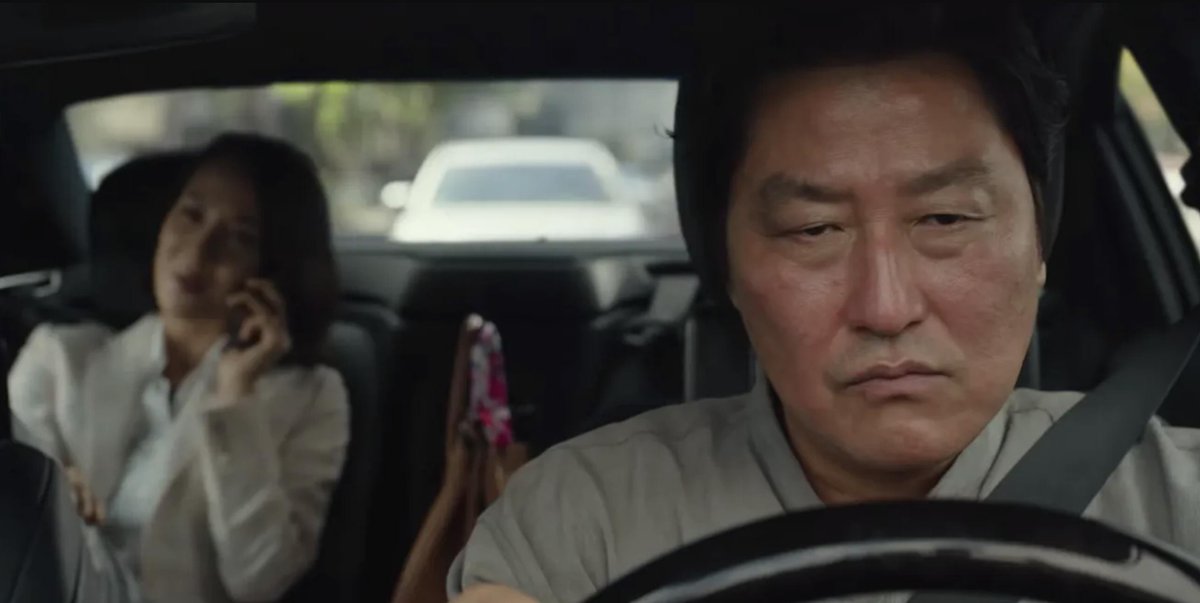
The Parks, as with the bunker, do not see the massive underclass living beneath them unless it directly affects their lives, as with the subway stench. Everyone lives according to their whims even if they are not harsh bosses. Bong Joon-ho also has a devotion to keeping the characters realistic – everyone in all three families has flaws. Ki-taek’s and Choi Yeon-gyo’s are on full display through the shopping trip, and neither one of them realizes it of the other. The hostess calls all her friends and invites them to enjoy themselves without a care in the world while overworking the staff that make it possible, while the driver’s anger seethes. The words from earlier ring in his head as Choi Yeon-gyo rolls down the window to cover his smell, which is no doubt made worse by his aquatic struggles the night before.
Chung-sook goes through a similar struggle at the compound, as she has to drag heavy tables from the basement and set them up on her own, and is then shushed for being too loud while doing so.
The crowd at the impromptu party seems to be well-dressed, and have presents at the ready, even for a spur of the moment occasion, whereas the impromptu nature of the occasion might have been more difficult for someone with fewer resources. Ki-woo remarks to Da-hye that “even for a sudden gathering, they’re so cool.” The screenplay does not give Jung Ji-so much to do in portraying Park Da-hye, but her hesitance in lying to Ki-woo when he asks if he fits in showed great attention to detail. It is after this that Ki-woo sets himself to complete his mission.
Outside, Ki-taek and Dong-ik hide in the bushes, putting on headdresses. The conversation with Park trying to make them equals, apologizing for the get-up and trying to relate to him, but ends it by ordering him to think of the occasion as part of his work, revealing that they are inseparably not equal; Park always holds power over him.
Ki-jung and Chung-sook reunite in the kitchen, and are the only ones to talk over the events from the night before. Both agree that the situation had escalated, and that they should come to a compromise with the basement dwellers, but fate intervenes in the form of Choi Yeon-gyo ordering Ki-jung again, this time to play the part of a princess for Park Da-song. Her choice of words, saying that “it needs to be you,” display that Ki-jung is a resource to her, to be arranged like a mannequin, like the rest of her hired help.

Meanwhile, Ki-woo enters the bunker, but drops the stone and has no idea that Geun-sae is free. The crazed man, blood all over his face, bashes Ki-woo’s head in with the scholar’s rock and makes his way out to the party as Bong Joon-ho transitions to an elegant outdoor music performance. The director has dealt with dualities throughout the movie, and it is a testament to his and Hong Kyung-pyo’s skills that Geun-sae can look so startlingly out of place aboveground; It is almost as though they have shot a crossover between two distinct movies.
The cinematography makes the initial shot of Geun-sae at the edge of the crowd look believable but absurd, with a wild juxtaposition between the blood on his face and the meticulously put-together rich crowd. Mayhem ensues. He sprints to his next target, Ki-jung, and stabs her in the middle of the party. Suspense and comedy come together as the young lady, defiant to the last, shoves cake in his face as she dies. Park Da-song seizes, of course, at his ghost having come to life and stabbed his favorite teacher.
Geun-sae and Chung-sook duel as the two fathers rush from the bushes to tend to their children. The guests run screaming, and all attention is paid to Da-song as Ki-jung bleeds out on the grass. Dong-ik screams at Ki-taek for the keys, but then Ki-taek breaks fully. The final indignity, the breaking point beyond which he cannot suffer, is when Park recoils at his scent in the midst of saving his son’s life.
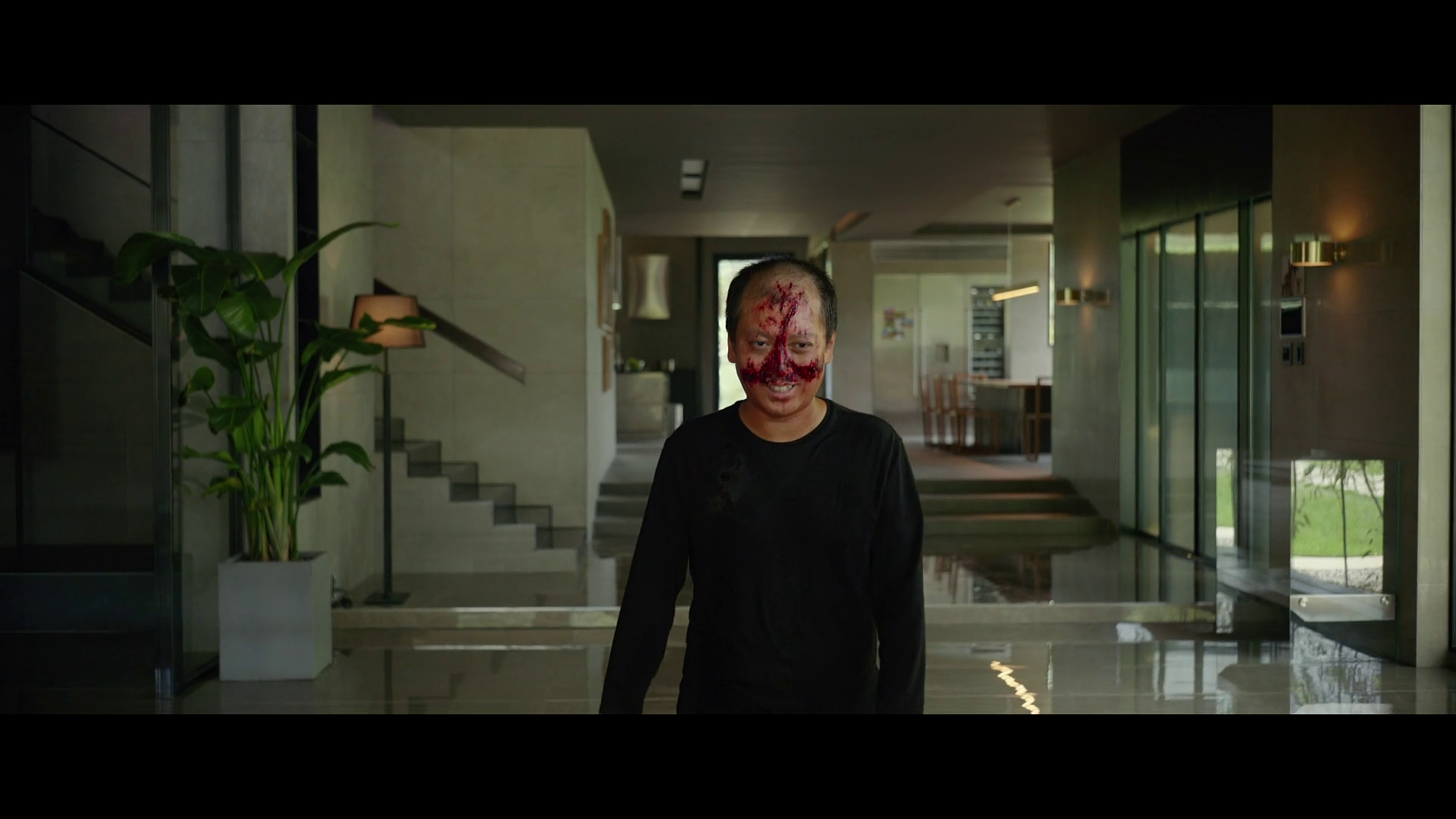
The two tones meld perfectly as Geun-sae finally meets the man who has housed and fed him these past four years, and the murderer, covered in blood and frosting and stabbed with a meat skewer, yells “Respect!” Dong-ik is able to get the keys; However, Ki-taek grabs the knife and stabs him, coming full circle. He had called the family nice, had asked “What did [they] ever do wrong?” But when Ki-taek realized the contempt that a man must feel to hold his nose at a scent even as his son dies, he could not bear it, and snapped. Choi Yeon-gyo collapses at this point, and a brilliant tracking shot follows Ki-taek down the stairs, until it fades to black.
Nonetheless, the gravity of this moment does not last long. Ki-woo wakes up in the hospital, and a Bong Joon-ho inserts a gag about how he keeps laughing through his Miranda rights. The police have found out everything, and he and his mother are on probation in the hopes that they will eventually make contact with Ki-taek, so that he can be arrested. The poetic nature of the dialogue carries the exposition-heavy voiceover, and the director’s focused attention to detail shines through, as with Ki-woo working at Pizza Generation after all, or with shots of a bus bookending the Kim family’s involvement in the Parks’ story.
Mountains continue to follow Ki-woo, and he climbs one to get a view of Namgoong’s compound. There, pieces of foreshadowing about Ki-taek’s age and Ki-woo being a boy scout come together to allow the father to give his son one last message. His monologue details how he escaped, and how he now lives exactly as Geun-sae, down to talking to the picture of Park Dong-ik. The shot of him crying yet unable to wipe his tears because of the blood on his hands is affecting, and he finally seems to have given up, ending on “so long.”

Ki-woo writes a letter in response, without a way to send it. He is younger, hopeful, and his missive reflects that; Whereas Ki-taek dwelled endlessly on what had happened, Ki-woo obsesses over the future. He promises to make enough money to buy the compound, and free him, fantasizing over enjoying the backyard as his own and freeing his father. As when he said he would go to the university his fake degree is from, he wishes to make the lie real. The fantasy sequence ends, though, to reveal snow piling up outside the semi-basement, and another “so long.”
With suspense, comedy, and a social message that is presented simply yet powerfully, Parasite is a movie that is easy to understand for casual audiences, infinitely complex for film addicts, and entertaining enough for both.
A+

 Disassembly
1 Comment