
“I’m not fighting for anything anymore except myself.”
Notice: The following contains spoilers and rambling thoughts about the movie Casablanca.
If you want focused writing, read The Atlantic.
Casablanca is a story of people negotiating the demands of their environment while wrestling with temptation and their conflicted natures. Director Michael Curtiz establishes the setting in a map overview using stock footage: In the midst of World War II, thousands are fleeing the Nazis in Europe, attempting to escape to America. The best city to leave the continent is Lisbon, and the best way to get to Lisbon is through Casablanca, in French Morocco. Although France has already surrendered and the German-aligned Vichy government is in power, the Nazis do not occupy French Morocco, and Free French resistance forces lurk in the underground, alongside criminals. The town is comprised of refugees, all needing an exit visa to board a plane to Lisbon, and safety. These visas come from the black market criminal Ugarte, or the corrupt Vichy chief of police, Captain Louis Renault. At the center of this is Rick’s Cafe Americain, the main source of entertainment and home to many colorful characters, a den of gambling, drinking, music, and conspiracy, owned by American expatriate Rick Blaine. Thus, Casablanca is a sort of purgatory in the desert, and nearly everyone who lives there is a sinner in some way.
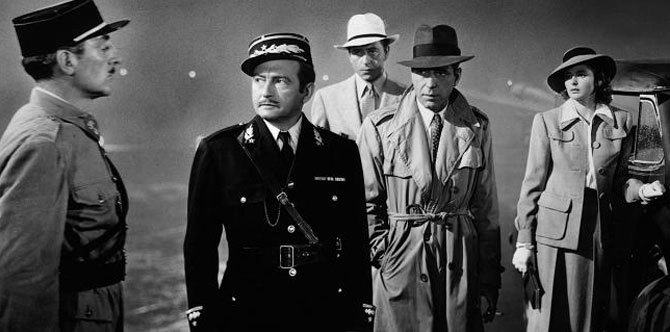
Into this stability come two refugees unlike the others. Victor Laszlo and his wife Ilsa Lund are members of the anti-Nazi resistance, with Victor famously having escaped the Nazis after reportedly being killed five times, once from a concentration camp. The German state police, the Gestapo, believe that if Laszlo escapes, he will be able to coordinate the resistance movements in different countries, and his presence brings Major Heinrich Strasser and a cohort of Germans into town to keep him from the one tool that might save him: Two exit visas guaranteeing safe passage that were stolen from the Germans. And as important as Laszlo is to the war, Ilsa Lund is equally so to Rick, with the two sharing a passionate history unknown to her husband.
Professional cool guys have a lineage going back to Rick Blaine – the Han Solos and Indiana Joneses of the world would likely look very different without him. His sarcastic, clipped dialogue convey his character from the very start as someone world-weary and suspicious; Rick has adapted perfectly to life in the corrupt town of swindlers. Rick does not act to increase his mystique – he acts in a very straightforward manner in his business meetings and romantic liaisons, ignoring most of the people around him, which only makes him more fascinating to them. The screenwriters – the Epstein Brothers and Howard Koch – set up Rick’s introduction expertly – all the main characters barring Ilsa and Victor are introduced before him, and they often discuss him, building up his reputation before the audience glimpses him. Captain Renault reassures Strasser that the thief who stole his exit visas will be at Rick’s, simply because “everybody comes to Rick’s.” His German waiter rebuffs ladies who want to speak to Rick, and plays up his legend by saying that the second-biggest banker in Amsterdam would not impress him. Once inside his gambling den within the cafe, the shot of him signing the money order as he plays chess against himself establishes both his power in Casablanca and his struggle against himself.
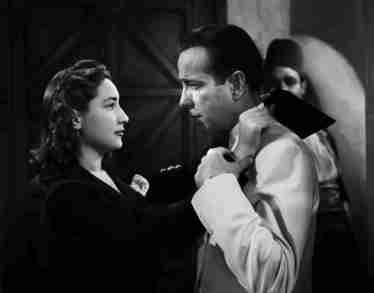
However, Rick has more depth than simply the intrigue he inspires or the power he wields. Humphrey Bogart displays range beyond the stereotypical noir tough-guy/depressive, illustrating Rick’s romanticism in Paris when he and Ilsa are together in flashback. This version of Blaine, going by Richard and not nearly as bitter as his future counterpart, acts almost sappy in his treatment of Ilsa, and the sentimentalism that he is later accused of hiding is on full display. This gives further depth to his struggle. Rick has the opportunity to take everything he has ever wanted: He has two exit visas, a blessing from Victor Laszlo, and Ilsa Lund’s full acknowledgement of their love. Yet, he manages to resist the temptation. The flashbacks, and brief flashes of “sentimentalism,” are the only signals to the audience early in the film that Blaine is someone to root for and not simply unravel – as well as his treatment of Sam.
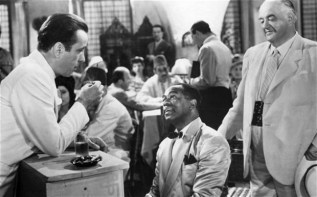
The piano gives Sam his introduction; His good-natured playing of a love song hints at his role in Rick and Ilsa’s romance and his own decency. Unfortunately, Sam presents an example of the film being slightly weighed down by the racial politics of the era – it is odd to hear Ilsa Lund call a man of Sam’s age a “boy,” for instance, and he is not given an internal struggle like the majority of other characters. Dooley Wilson’s rendition of “As Time Goes By” is rightfully considered a classic moment in cinema and music, evoking memories in both the characters and audience when he plays it. More than his star entertainer, Sam is Rick’s friend, knowing him at least since Paris and possibly further back, in Rick’s gun-running enterprises in Ethiopia and Spain. He attempts to protect Rick from Ilsa’s return, and in Paris he keeps Rick moving onto the train, saving his life from the invading Nazis. He tries to keep Rick on an even keel when Ilsa’s return has clearly disturbed Rick, drinking to the point where he is “getting to be [his] best customer.”
For her part, Ilsa feels equally bothered by her reunion with Rick, although less outwardly. Part of her restraint, of course, is her husband, who acts as though he suspects nothing even though every moment between Rick and Ilsa is charged with tension. Others tell Rick’s backstory, while Ilsa gives her own – however, because she speaks to Rick several times and they fail to actually communicate, when the audience finally hears her out, it feels earned rather than coming across as clunky exposition. Her conflict is like Rick’s, borne out of love; She must choose between continuing on with her work in the resistance, or the love of her life.
Her initial actions in Paris and her earlier conversations with Rick make Ilsa Lund seem like an unconscionable liar, incapable of telling the truth to either her lover or her husband. However, the movie turns audience expectations around with a well-established reveal – she believed Laszlo to be dead while in Paris, a belief foreshadowed by the earlier line that his death had been reported five times. While this would seem to be a simple reveal to modern audiences accustomed to plot twists, Ingrid Bergman emphasizes the emotional weight of her decision to leave Rick clueless to avoid endangering him, and the struggle she has hidden over the ensuing time.
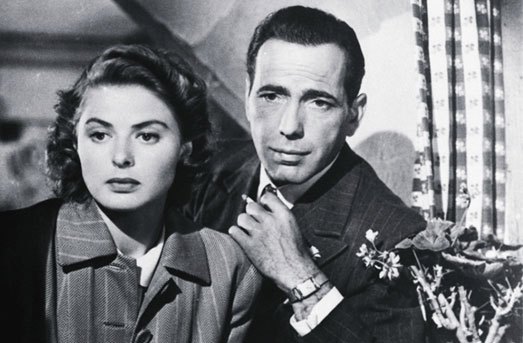
This time has been spent with the inspirational Victor Laszlo. They have schemed with resistance movements and been one step ahead of the Nazis across half of Europe; In fact, it could count as an interesting choice from the Epstein Brothers and Koch not to make him the protagonist. Paul Henreid portrays him with a calm demeanor, and portrays this calm demeanor as having been earned through long suffering. Even Rick is something of a fan, and Curtiz has characters remark on Laszlo’s reputation in a similar way. At one point, he even instigates a battle of the bands in Rick’s, having “La Marseillaise” drown out a German drinking song. Despite this, Victor is human, and has a struggle of his own. Despite not letting on that he notices the chemistry between Rick and Ilsa, he knows that they were together, and gives Rick permission to use the exit visas on himself and Ilsa; Even the legendary Victor Laszlo, known for his vital work in exposing the Nazi concentration camps, is willing to die in Casablanca and surrender his life’s work for love. Despite the enormity of his choice, Laszlo never loses composure, and always has a retort for his fascist counterparts.
His main counterpart, although not a full-fledged fascist, is Captain Louis Renault. The head of the police in Casablanca abuses his position for self-interest, but not for evil in the fashion of the Nazis. He will pressure Rick’s into letting him win at the roulette table, and he will take advantage of the desperation of refugees who need his signature on exit visas, but his actions are mainly driven by self-preservation – he cheerfully admits that “the prevailing wind happens to be from Vichy,” and he has no ideology himself. Instead, he notices his friend Rick change when the couple arrives, and this in turn spurs him to change, leading to the classic “beginning of a beautiful friendship” at the film’s close.
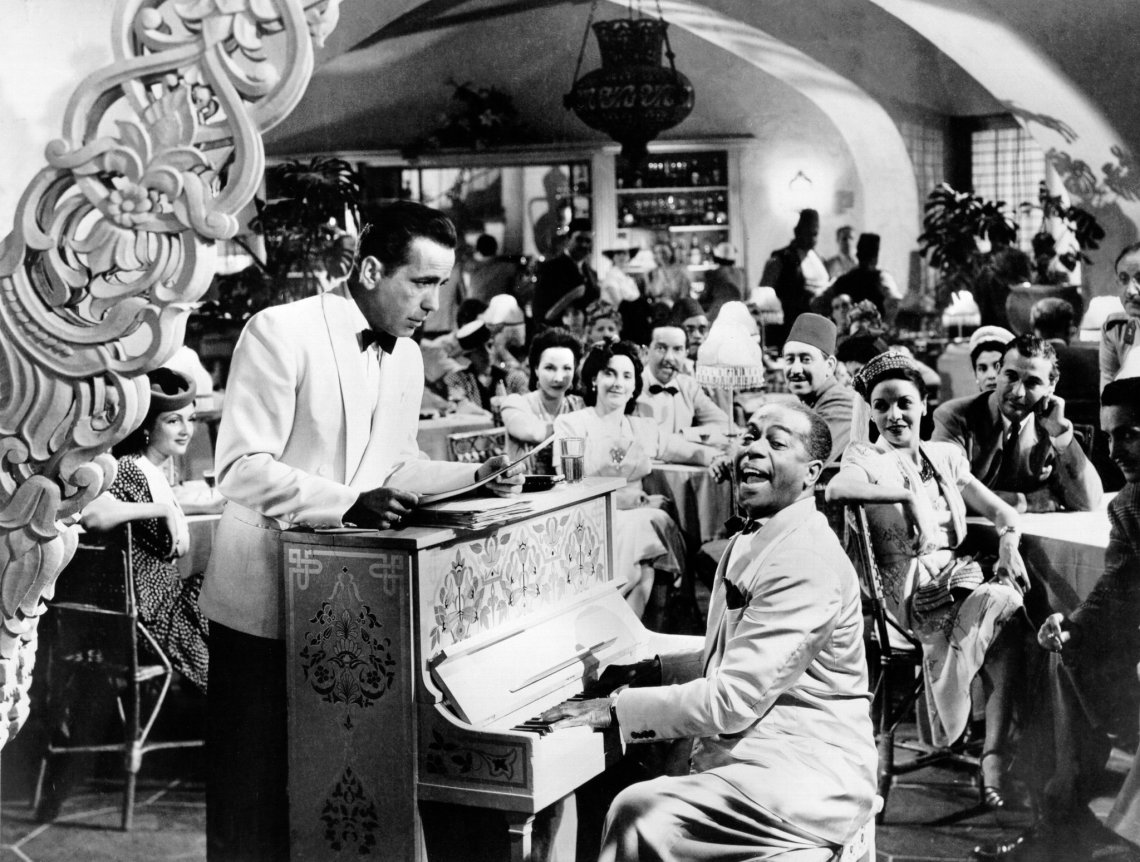
Curtiz employs quick details to reflect deep meaning: From his first line the audience can tell that Rick is a misanthrope, a hard nosed broker who has made his way in Casablanca by providing a stage across which drama and the need for escape play out daily. The audience knows they can sympathize with Rick at least partly from the outset, with his attitude toward the Germans when he tells Ugarte that he is impressed with him after their murder, as well as ripping up the check they give at his bar. Rick and Victor’s conversations are also weighty, if brief. Victor rekindles Rick’s will to fight against fascism, and at the end, Rick lies to make it seem like Ilsa only faked loving him, to save Victor’s marriage and enable him to leave Casablanca.
One often-overlooked aspect of Casablanca in the public consciousness is just how funny it is. There are classic lines scattered throughout, of course, but every main character except the Nazis has at least a few jokes delivered through the Epstein Brothers’ and Koch’s witty dialogue. There are also dedicated gags; A German couple going to America practices their English, but translates everything literally, and a pickpocket decries the “vultures” of Casablanca while rifling through pockets.
Even the setting is iconic; Most of the bazaars and crowded street markets of film owe something to the loud stalls and haggling venders of Casablanca. During the night scenes, Curtiz contrasts the spotlights of the cafe with the floodlights on the roof enforcing curfew. One other shot that conveys meaning appears in flashback. Rick, waiting outside the last train leaving Paris for Ilsa, receives a letter from her telling him that they must never see each other again. He reads it, shocked, in the middle of a downpour, and the ink runs like mascara in rain, making the audience think of Ilsa just as Rick does.
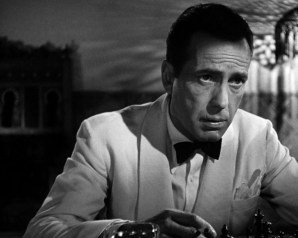
Despite this, these are the only notable uses of cinematography in the film. The majority of the sequences are not dynamic, and even the shooting of a French resistance fighter or the arrival of a Nazi plane are done in a fashion that is functional rather than exceptional. Cinematographer Arther Edeson uses common techniques for the time – the chiaroscuro lighting to frame Rick in darkness, for instance, or using a soft focus on Ingrid Bergman to emphasize her beauty and earnestness, but these are not unique.
Despite the classic nature of the film, Casablanca does present some issues and some limitations from the time period. The Free French spy dies too stiffly, and out of sync with the gunshot, and the film relies on stock footage to show the German invasion. In addition, the flashback sequences in Paris make heavy use of rear projection. However, these are all minor grievances, most of which are easily overlooked. The stock footage was all too current in 1942, and the rear projection is forgivable because the attention is on Rick and Ilsa. Their expressions, especially that of the younger, more optimistic Rick, occupy the foreground.
When discussing a film released in 1942, it is important to mention the change in culture, and any shifts that may be jarring to a modern audience. The Transatlantic accent aside, not much has changed, because fundamentally Casablanca is “still the same old story,” – recognizable in any time. Michael Curtiz gives Casablanca arguably its greatest strength by playing up timeless aspects of storytelling: Emotion, chemistry, and dialogue. This allows the film to stand tall eighty years later – holding up better than, say, a good effects-driven film of the time would have.
It isn’t many films that have WWII espionage, truly heartfelt romance, and a battle of the bands.
A+

 Disassembly