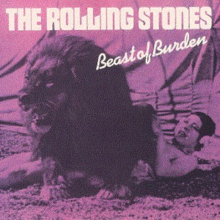
“Beast of Burden” is the song of an infatuated young man to his muse, a “pretty girl” that has denied him, making him contemplate his past and his desires. Songwriters Mick Jagger and Keith Richards paint the picture of a damaged individual unable to move on from the past in this bluesy rock song.
I’ll never be your beast of burden
My back is broad but it’s a hurting
All I want for you to make love to me
I’ll never be your beast of burden
I’ve walked for miles my feet are hurting
All I want for you to make love to me
From the first verse, the speaker lays out his perspective on his love interest, and his internal conflict. A slow guitar comes in, alone – fitting, as the first line precludes any commitment between the speaker and his interest. The second line hints at one explanation; The speaker has had negative experiences before. In keeping with the song’s labor motif, his back hurts from all that he’s done. His past commitments have left him with an ache, just as his “feet are hurting” from the miles he’s walked. Due to this, he settles for comfort from immediate, hedonistic pleasures, boiling down any complex desires into just wanting her physically. He links the emotional connection to pain, implying that the “burden” degrades him.
Am I hard enough?
Am I rough enough?
Am I rich enough?
I’m not too blind to see
With the chorus, the back-up singers come in, joining as a sort of Greek chorus to the situation. The speaker goes on to introspect, wondering at all the superficial factors that might attract someone and whether he measures up, eventually deciding that he doesn’t. His reflection, perhaps tinged with self-doubt, leads him to the realization that the two will never be together in any meaningful sense. At the same time, it underestimates the object of his affections, only believing that she would be attracted to him for shallow reasons.
I’ll never be your beast of burden
So let’s go home and draw the curtains
Music on the radio
Come on baby make sweet love to me
His self-doubt coalesces into a self-fulfilling prophecy – if he and her do anything, it would only be physical, in part because he has “draw[n] the curtains” on any other possibility. In his scene of them together, he emphasizes another sensual pleasure, the “music on the radio,” again focusing on his need to keep their relationship at a surface level. He can never be emotionally close to her.
Am I hard enough?
Am I rough enough?
Am I rich enough?
I’m not too blind to see
The speaker follows a pattern common to people with self-doubting thoughts, and repeats the same fruitless sentiments to himself over and over. The chorus also showcases the speaker’s self-centeredness, as he fails to give thought to what her reservations are, believing she would fall for him if only he would fit his own criteria. The music swells with each chorus, rising as the speaker wonders and then falling with the verse, or in this case, the bridge.
Oh little sister
Pretty, pretty, pretty, pretty, pretty girls
Uh you’re a pretty, pretty, pretty, pretty, pretty, pretty girl
Pretty, pretty, such a pretty, pretty, pretty girl
Come on baby please, please, please
The bridge, as well as giving us the only indicator that the speaker is writing about a lady, showcases the speaker’s romantic nature. The speaker thinks repeatedly about “pretty girls,” and it may be that he’s had these thoughts about others before the song’s subject. He continues to overcompliment the object of his affection, and the repetition as well as the “uh” pause reflect nervousness. The back-up singers accentuate his hesitation by performing in high, plaintive voices.
I’ll tell ya
You can put me out
On the street
Put me out
With no shoes on my feet
But, put me out, put me out
Put me out of misery, yeah
This verse subverts more traditional lovesong elements, with the speaker volunteering to undergo hardships on behalf of his object of affection. However, in this case, he is not asking to be with his love interest; Rather, he wants to be free of the negative effects of his attraction, and them being together would be incidental.
All your sickness I can suck it up
Throw it all at me
I can shrug it off
There’s one thing baby
I don’t understand
You keep on telling me
I ain’t your kind of man
The verse recites more of the speaker’s internal monologue, citing that the speaker and his love interest would be good together, since he can “shrug off” her issues and “sickness.” This approach fails, somehow, and it is evidently not his first attempt, since she “keep[s] on” rejecting him as incompatible. The rejection is particularly unfortunate at this juncture, as he has agreed to shoulder the burden that he previously established as degrading, but because he fails to communicate, it’s a meaningless gesture to her.
Ain’t I rough enough, ooh baby
Ain’t I tough enough
Ain’t I rich enough, in love enough
Ooh, ooh please
The speaker once again gives his litany of insecurities, but this time the audience knows the reasons he doesn’t list; He’s let his past get the better of him, and in reducing his interactions with her to asking for sex, fails to respect her. He knows this, even acknowledging that he may not be “in love enough,” or not willing to show it.
I’ll never be your beast of burden
I’ll never be your beast of burden
Never, never, never, never, never, never, never be
I’ll never be your beast of burden
I’ve walked for miles, my feet are hurting
All I want is you to make love to me
Yeah
As he once fixated on the “pretty girls,” here he similarly repeats “never,” trapped by the thought of being alone and his conviction that surface pleasures will erase the pain from his past. He continues to complain about his pain, but without resolving it, his self-expression is useless. The instrumentation continues as before, slow and measured with the drums and bass, and mellow and erratic with the guitars, reflecting both his disordered thoughts and the inevitable conclusion they bring him to.
I don’t need the beast of burden
I need no fussing
I need no nursing
Never, never, never, never, never, never, never be
His defiance in the outro is also a lament. He declares himself independent of commitment, and tellingly, claims he doesn’t need “the” beast of burden, dismissing the whole practice. In his anger, he calls himself superior to others in relationships, comparing them to infants who need “fussing” and “nursing.” He emphasizes his denial by repeating never once again, as the song slowly fades out, as do his hopes for the future romance.

 Disassembly