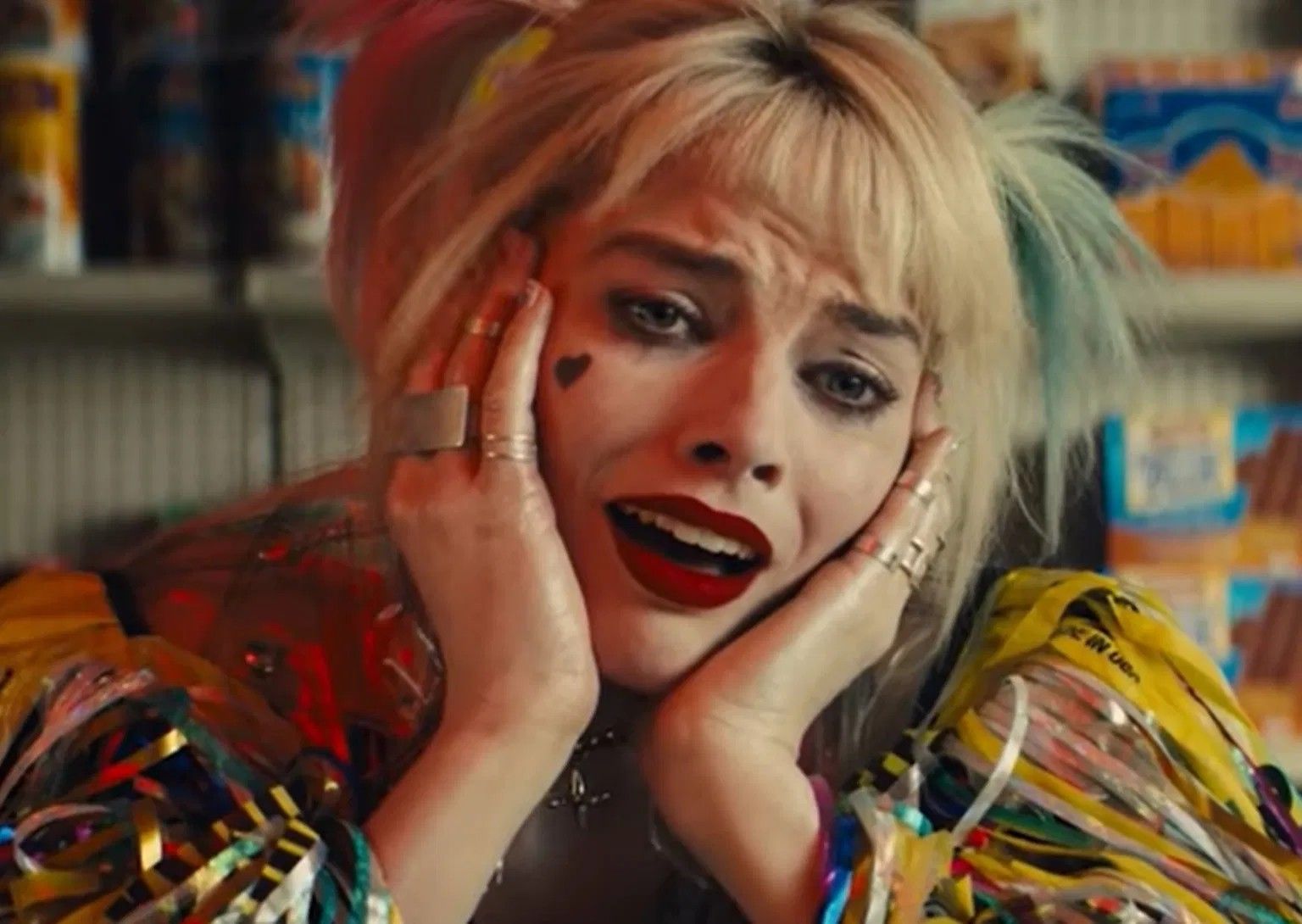
“You’re really not as complicated as you think.”
Notice: The following contains spoilers and rambling thoughts about the movie Birds of Prey (And the Fantabulous Emancipation of One Harley Quinn).
If you want focused writing, read The Atlantic.
Harley Quinn has been one of the breakout characters of the DC Extended Universe. As the DCEU has had struggles with coherent storytelling and entertaining ensembles before, the goals for Birds of Prey were to capitalize on and extend Harley Quinn’s popularity, build up their cast of popular characters for spin-off properties, and prove that they can manage a superhero team-up. They are only partially successful.
Since the beginning of her career as a villain, Harley Quinn has been inextricably tied to the Joker. He created her, and the two are a dark parallel to Batman and Robin in their closeness and also their relative popularity; It is easy to have a solo Batman or Joker project, but focusing on Robin or Harley has been more challenging.
Until Margot Robbie. Her charismatic performance has strengthened the trashy antiheroine to the point where she has a standalone duology. She makes Harley Quinn relatable, if not always likeable; A self-destructive streak after a break-up and finding friends to rely on are two elements that most audiences can understand, after all. Director Cathy Yan tells her story and that of the other Birds in a schizophrenic style, with rampant flashbacks and noiresque voiceover explaining character motivations and backstory.
Birds of Prey is an introduction for many characters, and there are issues of the multiple origin stories. Even Quinn, whom we’ve seen before, has an animated life story at the beginning of the movie. Her relationship with her father, wherein she is abandoned over and over and keeps returning, foreshadows both her relationship with the Joker and her persistence. The film frequently takes breaks from the ongoing plot to flash back and explain why a character is present or what their motivations are, losing momentum in more than one instance because of it. Yan seems to have taken inspiration from nonchronological movies such as Pulp Fiction (even giving Harley the same pick of weapons Bruce Willis had), but since Harley has to explain exactly what has happened and literally rewind the film at times, the effect makes the movie feel disjointed, which would be a yet greater issue if the plot was anything but boilerplate.
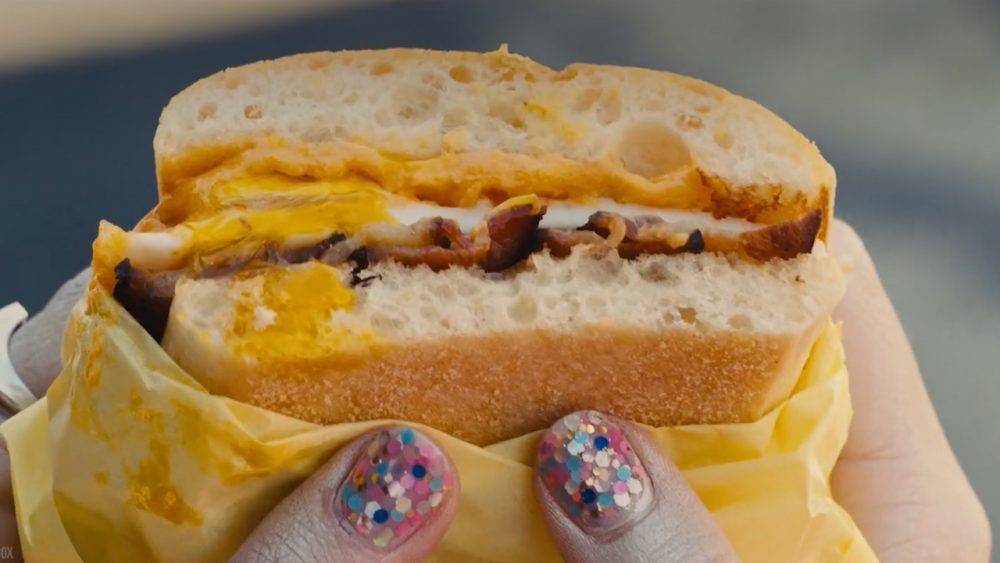
Screenwriter Christina Hodson mostly succeeds at presenting Quinn as our relatable viewpoint character, but at times her writing makes it seem forced. Harley’s obsession with breakfast sandwiches was likely meant to be quirky and relatable, and the time and melodrama invested in it would be funny, but its obviousness made it fall flat. In general, the film is unsubtle. This is entirely in keeping with Harley Quinn’s character, of course, and soundtrack lines like “The joke’s on you” and factories blowing up like fireworks are part of Harley’s unreliable narration, but the end result was less entertaining than the similarly bombastic and voiceover-heavy Deadpool. Luckily for the film, Margot Robbie herself is an asset, and gives an animated, comedic performance. A nice piece of writing from Hodson is how often Quinn uses her training as a psychiatrist – after all, you don’t just forget twelve years of schooling because of your chemical romance. Despite this, Hodson has given her mostly unengaging material, often relying on thoughtless vulgarity as a crutch. Crude humour shines in movies exactly like this one, and some of the dialogue is clever, but the film can’t realize that “fuck” on its own is not a joke.
In a mixed blessing, the same can be said for a lot of the cast, who do well playing types audiences will surely find familiar. Ewan McGregor is a good villain as the power-mad Roman Sionis, the Black Mask. From his ‘80s Miami jackets to his mercurial persona, he’s engagingly over-the-top and the classic bipolar mastermind, and Chris Messina is the stereotypical henchman serial killer as his second-in-command, Victor Szasz.
Unfortunately, the Bird given the second or third most attention is not as attention-grabbing. Rosie Perez as Renee Montoya is even introduced as someone who has watched too many ‘80s cop movies, but does not move out of the typical arc for such a character. Her performance is probably the most subdued, and without the alter ego (she is not yet the Question) and flash of her counterparts, she comes off as less compelling.
Mary Elizabeth Winstead plays Helena Bertinelli, the Huntress. She’s a Batman who enjoys her job, and we get too little of her, despite her backstory being predictable from the moment we see a family gunned down on-screen. Unlike Captain Marvel in Endgame, she actually is cool despite the other characters constantly telling us how cool she is. Winstead plays her as awkwardly as an orphan raised by assassins would behave, and her crossbow shots and rage issues are equally entertaining to watch, but the character does have range – Huntress comforts young Cassandra Cain in much the same way Canary does earlier in the movie.
/cdn.vox-cdn.com/uploads/chorus_image/image/66273616/rev_1_BOP_06798r_High_Res_JPEG.0.jpeg)
Ella Jay Basco plays Cassandra Cain, a disaffected pickpocket and aspiring criminal. Her delivery is somewhat odd throughout the film, coming across as particularly stilted just prior to the climax when she holds a gun on the Birds of Prey – two of whom she knows and has only had positive relations with, in a weak display from Hodson.
Sal, a cook who is onscreen for perhaps a minute, is the only male portrayed positively in the movie, unless you count the cop who says “Cell 7!” during the police station raid.
Jurnee Smollett is Dinah Lance – Black Canary, the Bird with the second most screen time. The character itself is good, and Smollett plays her accessory-to-crime-grows-conscience arc well, but the messaging surrounding her is hamfisted. She is introduced in Sionis’ club as a caged “little bird,” singing verbatim “This is a man’s world.” Female empowerment is a fine motif for a film to have, but this blatant symbolism is more suited to Harley’s segments, as Canary is much more of a reserved and pragmatic character, acting covertly to tip the police multiple times.
The film’s underlying message is as conspicuous elsewhere. Cramming this much storytelling and establishing all these characters in under two hours makes the film compressed and overly reliant on shorthand, as when Yan sets up Quinn’s arc by having a group of women gossiping that she was not “born to stand on [her] own,” or when Harley presents her issue by saying, “A harlequin’s nothing without a master.” When the film is actually named The Fantabulous Emancipation, the audience does not need to be spoon-fed quite this much.

The voiceover is also excessive at times, such as when Harley admits “it was kinda nice having the kid around” while the movie shows them laughing and having fun. Basco and Robbie are both doing their jobs in conveying the information, and although it adds to the noir feel of the film, the voiceover feels like hand-holding in these cases. The music is also a mixed bag – the soundtrack’s choices fit their scenes for the most part, but any time music supervisors Gabe Hilfer and Season Kent pick a remix, the effect is distracting – notably a helium-powered rendition of “Sway” that butchers the song in record time.
The action presents another issue for Birds of Prey, in that it’s mostly forgettable – a major problem in a superhero movie with this many fights. With the exception of Canary’s close-in, kinetic fight in the alley against the kidnappers, and Quinn’s raid on the police station, the action does not stand out for its inventiveness in choreography or camera work. Even the brawl in the carnival funhouse at the end feels more gimmicky than actually unique.
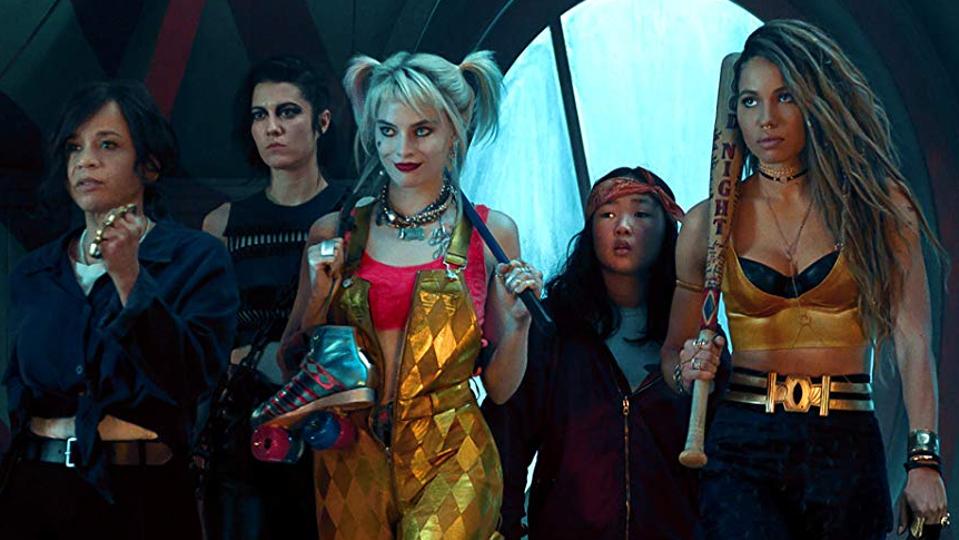
This climax also gives us our first look at the Birds of Prey all together – they only meet about twenty minutes before the movie ends. These are mostly fun characters, if uninspired ones, and it would have been better to see more of their chemistry. DC fails to live up to the title and put together a successful team-up movie. The stand-off with Sionis at the end is also somewhat strange – when Sionis is yelling “You can’t stand on your own, Quinn,” and “You need me” and Quinn is talking about his protection, it feels as though they cut a subplot about her following him willingly, which may explain the out-of-place dance sequence with the two of them earlier in the film.
Harley Quinn does not actually change much through the course of the movie. The Joker looms over the mercifully Leto-free production, but Harley begins her Fantabulous Emancipation on her own and continues in this vein throughout. She has her independence at the beginning and the end. Even when she sells Cain to Sionis, it feels more like a self-interested deal she made rather than running back into servitude. She acts largely the same. In the beginning, she leaves the group of women she was drinking with; In the end, she leaves the group of women she was drinking with and steals their car. Even her hair suggests this lack of change – her makeover from the beginning is a haircut from pigtails to slightly shorter pigtails. Ultimately, she expresses it best herself that she has ended up only “a less-terrible person,” but the rote journey is entertaining enough to enjoy with lowered expectations.
C+

 Disassembly